

Management Consulting 2026/27
Trends and Competencies in the Swiss Consulting Market
The leaders remain. The rules of the game are changing.
WGMB’s sixth Swiss consulting study reveals a market marked by remarkable continuity at the top – and by a profound transformation of its conditions for success.
Reputation remains an important advance of trust. Increasingly, however, what proves decisive is whether the promise a name stands for also holds up in implementation. Impact, results orientation and entrepreneurial co-responsibility are coming to the fore – and reshaping the relationship between consultants and their clients.
The study assesses the market position of the leading management consultancies in Switzerland and examines how client expectations and the demand for consulting are changing.
It draws on the assessments of 418 senior executives at large Swiss companies.
Read the foreword (in German) • View the table of contents (in German)
What is driving the Swiss consulting market
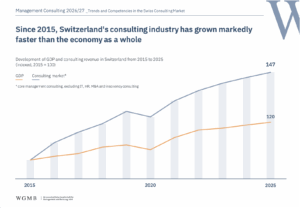
Since 2015, consulting revenue in Switzerland has grown by almost half – more than twice as fast as gross domestic product. Yet the conditions behind that growth are changing. Swiss companies face geopolitical, technological and economic pressure all at once. The strong franc, trade-policy uncertainty, subdued growth prospects and the rapid advance of artificial intelligence are shifting their strategic priorities.
The demand for consulting is realigning. What is called for is no longer visionary forecasts of long-term developments, but robust contributions to the immediate stabilisation of the business, to harnessing new technologies and to implementing necessary change.
In parallel, the consulting industry itself is changing. Artificial intelligence, margin pressure and new fee models are reaching into its business models.
What the study examines
Stable names – a new yardstick
In clients’ judgement, the Boston Consulting Group leads ahead of McKinsey and Bain – a trio that has held its order for years. The real movement lies not among the market leaders, but in the criteria by which they are measured.
Today, above all, it is implementation capability that is in demand: the ability to embed a solution effectively in the client’s organisation so that it genuinely takes hold. On this, the most important test of all, two restructuring specialists – AlixPartners and Alvarez & Marsal – come out on top. The industry’s former badge of prestige, thought leadership, recedes markedly in the ranking of selection criteria.
Demand is shifting
Even in uncertain times, companies are not cutting their consulting budgets – they are setting different priorities. Stabilisation, cost reduction, restructuring, artificial intelligence and the adaptation of business models are gaining in importance, while other topics lose urgency.
For consultants, then, the question is not only how large the market will be in future. What matters more is whether their competence profile fits the tasks for which clients are actually seeking support.
AI makes knowledge more readily available – and judgement more valuable
Artificial intelligence speeds up research, analysis and data evaluation. As a result, part of the traditional knowledge work loses the scarcity value it once held.
What grows more valuable is experience, judgement, an understanding of context and the ability to embed change within an organisation. AI therefore does not simply replace consulting. It shifts what clients will be willing to pay for in future. And it becomes the central specialist topic on which companies most hope for support from consultants in their business.
What follows from the findings
How do we at WGMB interpret the findings? Read our assessment below.
Consulting is increasingly assessed like a conventional investment
A compelling strategy remains valuable. But it delivers an operational return only once it translates into better decisions, more efficient processes and measurable economic results.
For clients, other questions therefore come into focus: What does the consulting actually achieve? How quickly does the impact materialise? And who takes responsibility when implementation proves harder than expected?
Increasingly, consultants and clients are sharing economic risk more closely through success-based fees. The external adviser is becoming, in part, an entrepreneurial partner.
Shared risk requires shared control
Success-based projects do not automatically lead to better consulting. The intended impact arises only when objectives, success criteria, data access, decision rights and responsibilities are clarified before the project begins.
For consulting clients, this means:
- They must find not only a suitable consultancy, but also an appropriate service, fee and risk model.
- They must define the intended success in precise and verifiable terms, enable decisions, provide relevant data and establish internal responsibilities.
- Responsibility for the success of the transformation remains with them – even under success-based fees.
For consultants, this means:
- They can credibly take on shared economic responsibility only if they have sufficient influence over the outcome.
- Assumptions, dependencies and the limits of their own responsibility must be agreed transparently.
- Specialist expertise alone is not enough. Equally important are the ability to implement, strong teamwork and a deep understanding of the client’s organisation.
The client remains a co-producer of the consulting’s impact.
Different perspectives must be brought together
Board directors and members of the executive management assess consultants from a different perspective than budget holders and project leaders. The former look more to the strategic contribution and the reassurance of a renowned name; the latter experience the consulting at first hand in the project work.
Both viewpoints are valid. A careful choice of consultancy brings them together. Whether a solution holds becomes clear only in implementation.
A clear profile matters more
Global scale, specialisation, industry expertise and particular strength in implementation can be different routes to success. But they must fit a consultancy’s value proposition, its partnership model and its actual competence.
Breadth alone does not create a strong market position. What is decisive is what the consultancy credibly stands for in the eyes of its clients.
About the study
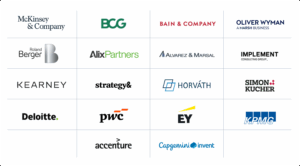
WGMB has been studying the Swiss consulting market since 2009. This sixth survey draws on the assessments of 418 senior executives at large Swiss companies. It examined 18 leading management consultancies, including the consulting arms of the four large audit firms.
Six areas of investigation structure the study: market position, client satisfaction, reputation, perceived competencies, consultant selection and future demand for consulting.
The full study volume contains:
- detailed analyses of the consultancies examined,
- long-term comparisons of client satisfaction at the top of the market,
- competence profiles and analyses of client satisfaction,
- comparisons between different decision-maker groups,
- insights into consultant selection, and
client expectations for the development of consulting budgets across ten topic areas.